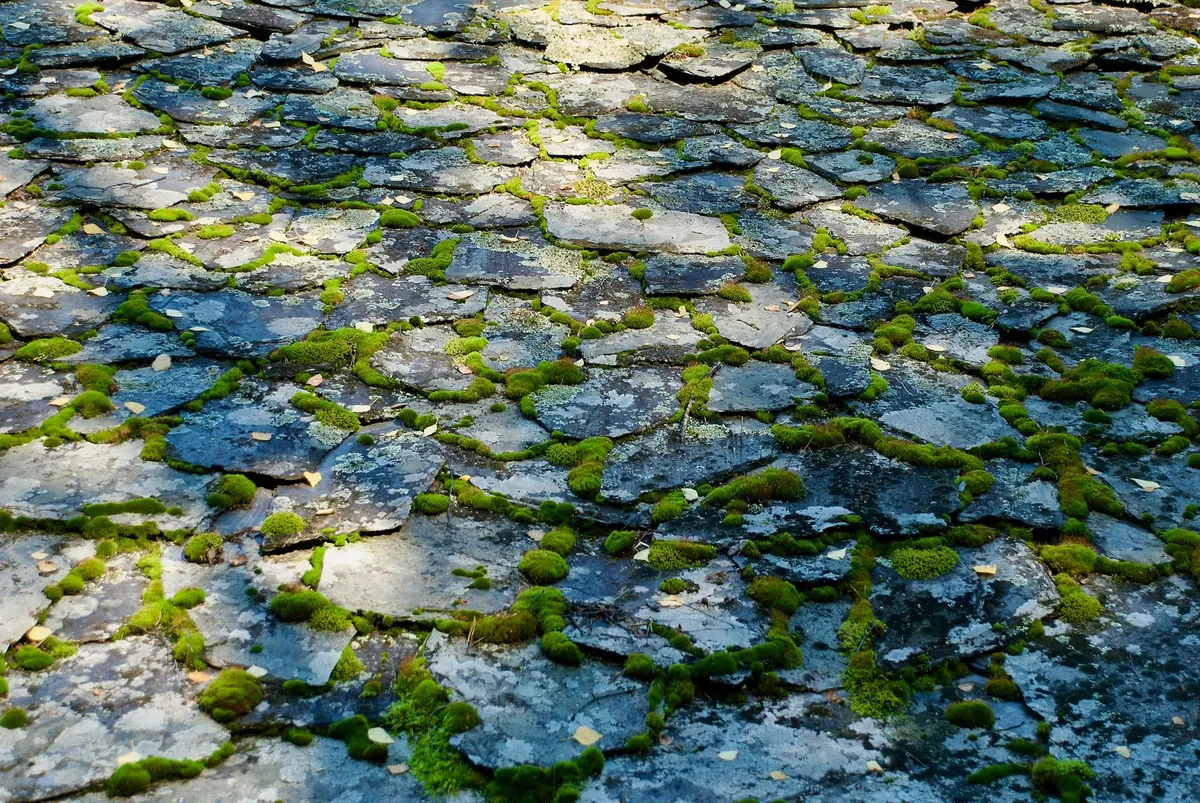
Run your hand over the green film on a shaded path and you will usually pick up one of two things: moss or liverwort. Most of us lump them together as "that green stuff" and reach for the same stiff brush. But they are genuinely different plants, with different structures and different preferences, and which one you have changes both what it means and what is worth doing about it.
Two plants, one damp habit
Mosses and liverworts are both bryophytes: small, non-flowering plants with no proper roots and no seeds. They take in water and nutrients across their whole surface rather than through a root system, which is why they need damp conditions and why they do so well in a British climate. The two groups parted company a very long time ago, though, and the difference shows once you know where to look.
Neither does your path or your soil any direct harm. They colonise surfaces other plants cannot use, they shelter tiny invertebrates, and they hold moisture that keeps a surface cooler in summer. The question is simply whether they are growing where you want them.
It helps to think of them as indicators rather than invaders. Moss is the generalist: it can survive on walls, roofs, tree bark, gravel, lawns and paving, and it tolerates drying out far better than liverwort. Liverwort is the specialist: it wants moisture that lingers, low light and a stable surface, and it often appears where air movement is poor and water has nowhere to go. A patch on a path is therefore less a random event than a small report on the conditions around it.
How to tell them apart
Look at the leaves
Mosses have tiny leaves arranged spirally around a stem, like a miniature conifer. Most of those leaves have a midrib — a nerve running up the centre — and taper to a point. Leafy liverworts also have leaves, but they sit in two flat rows along the stem, sometimes with a third row of smaller underleaves beneath. They are often lobed or notched and have no midrib at all. Once you have seen the two side by side, spiral-versus-rows is hard to unsee.
Common mosses on paths include silvery thread moss (Bryum argenteum), which forms tight grey-green cushions in paving joints, and feather mosses such as Hypnum cupressiforme, which trail over walls and stones. Leafy liverworts are more likely in damp turf or on rotting wood; Lophocolea bidentata is a frequent example, with two rows of pale green leaves and a distinctive forked tip.
The flat ones give themselves away
The easiest liverworts to recognise are the thalloid ones: no leaves at all, just a flat green strap of tissue pressed against the ground, like a strip of leather with a faint pattern stamped on top. Marchantia polymorpha is the classic example, and it often carries little crescent-shaped cups along its back, each holding a cluster of tiny green buds. Lunularia cruciata has similar half-moon cups. Conocephalum conicum looks like snakeskin and gives off a sharp, piney smell when crushed.
Fruiting bodies and feel
Both send up stalks topped with a spore capsule, but they differ. A moss capsule usually has a lid and a small cap, and often nods over on a curved stalk. A liverwort capsule is typically dark, splits into four valves when ripe, and sits on a very short translucent stalk. On the flat liverworts, that stalk springs from an umbrella- or shield-shaped structure held well above the thallus. In the hand, liverworts feel fleshier and more brittle; mosses feel soft and feathery.
Habitat clues before you kneel down
If the growth is on a sunlit wall, a roof edge, a tree trunk or a dry stone crevice, it is far more likely to be moss. If it is on bare, compacted soil under shrubs, in the shade of a fence, or in a path joint beneath a dripping gutter, liverwort is the stronger suspect. Liverworts also tend to form flat, continuous mats rather than the raised, cushiony tufts that many mosses make.
A two-minute field test
If you are standing over it now, work through this:
- Flat and ribbon-like, with no obvious leaves? It is a thalloid liverwort.
- Leaves present? Check the arrangement. Spiral around a stem points to moss; two tidy flat rows point to leafy liverwort.
- Hold a leaf against the light. A visible central nerve means moss.
- Look for cups or half-moon notches on the surface — those are liverwort gemma cups.
- Crush a small piece. An oddly sharp, medicinal smell is typical of several liverworts.
What liverwort says about your path
Liverworts are the fussier of the two. In a garden they turn up where conditions are persistently damp, still, shaded and compacted: the north side of a shed, a step that never dries, the corner of a patio where a downpipe discharges, the joints of a path beneath a dripping gutter. The thalloid kinds in particular want ground that stays wet for long stretches.
In borders you tend to see them on bare, compacted soil that never quite drains, often under dense shrubs or on heavy clay. A mat of liverwort does not steal nutrients, but it slows water infiltration and keeps the top layer of soil cold and airless. That can suppress seed germination and slow the warming of soil in spring, so the real issue is often the conditions, not the plant itself.
What moss says about your path
Moss is more tolerant and more widespread. On hard surfaces it usually means the same things — shade, moisture and a rough or porous surface that holds a film of water — but it does not demand constant wetness. It can dry out, go dormant and green up again after rain. A crack in a path, a worn mortar joint or a patch of gravel with fine silt is enough.
On a lawn, moss is often a symptom of compacted soil, poor drainage, low fertility, acidic conditions or grass that is cut too short in shade. It fills the gap where turf is thin rather than pushing healthy grass out. On walls and roofs, it is simply taking advantage of a surface that stays damp long enough for spores to settle and grow.
Does it matter which one you have?
Yes, because the two respond differently to the same treatment. Moss can often be discouraged by improving drainage, feeding the lawn, raising the pH with lime where appropriate, scarifying and raising the cutting height. Liverwort is less impressed by those measures. It thrives in damp shade, and many general moss killers are not labelled for liverworts. Scraping it can also make things worse: thalloid liverworts produce gemmae — tiny buds — and leafy kinds break into fragments, so a vigorous brush or pressure washer can spread it across the path rather than remove it.
That is why the first step with liverwort is almost always to change the environment: redirect the drip, clear the gutter, prune back the shade, improve airflow, open up compacted soil and stop overwatering. Once the surface dries more often, liverwort loses its advantage. Moss, by contrast, may need both environmental change and a period of physical removal or a suitable moss treatment, depending on where it is growing.
Managing each without wrecking the surface
On paths and patios, start with the least destructive option. Sweep or brush off dry moss and liverwort in spring, when growth is active but the surface is not soaked. Collect the debris rather than washing it into borders, because liverwort fragments can root again. If the surface is slippery, treat safety as the priority, but avoid harsh jet washing on old mortar or stone, which can erode the surface and create even better conditions for regrowth.
In beds, mulch bare soil, plant densely and avoid working heavy clay when it is wet. In lawns, aerate and scarify, overseed with a shade-tolerant mix, and feed in autumn. On walls, repoint crumbling mortar and trim back climbers that keep the wall permanently damp. A blockquote worth keeping in mind is this:
Treat the cause, not the colour.
Killing the green film without changing the damp, shade and compaction simply invites the next generation.
When to leave it alone
Moss and liverwort are not weeds in the usual sense. They provide microhabitat for springtails, mites, rotifers and tiny insects, and moss is used by birds and insects as nesting material. A mossy path edge or wall can be beautiful, and a liverwort mat in a boggy corner is a sign of a functioning damp microclimate. If the surface is safe and you like the look, there is no rule that says it must go.
The practical line is safety and purpose. If the growth makes a path treacherous underfoot, traps water against a wall you are trying to protect, or smothers seedbeds, manage it. If it is simply living on a damp corner you never use, leave it be and enjoy the fact that something is thriving there.
Photo: Przemek Leśniewski / Pexels